
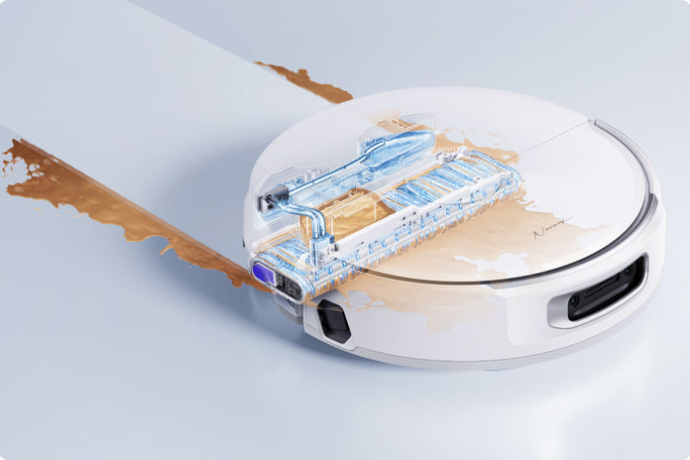
Robot vacuum and mop combinations have become a staple in modern homes, promising automated floor cleaning. While the vacuuming technology is well-established, the mopping function has seen significant evolution. Early systems often fell short, but recent advancements, particularly the development of real-time washing systems, have redefined what a robot mop can achieve. Understanding this progression is key to choosing a truly effective cleaning solution.
Early Mopping Systems and Their Limits
The first robot mops introduced a new level of convenience, but their methods were basic. These early designs laid the groundwork for the more sophisticated technology available today.
Traditional Flat Pad Mops
The most common and affordable design is the flat pad system. It consists of a microfiber cloth attached to the bottom of the robot. A water reservoir on the robot drips water onto the pad to keep it damp as it is dragged across the floor.
While simple and low-cost, this method has a major flaw. The pad quickly collects dirt and becomes saturated. Instead of cleaning, the robot can begin to smear dirt and grime across the floors, leading to cross-contamination and an incomplete clean. These systems are best suited for only the lightest daily maintenance.
Dual Spinning Pad Mops
An improvement over the flat pad is the dual spinning mop pad system. These models feature two circular pads that rotate at high speeds, providing an active scrubbing motion that is more effective on dried-on stains.
Despite the improved scrubbing power, these systems share a fundamental limitation with flat pads. They do not separate clean and dirty water during the cleaning process. Once the pads absorb a certain amount of dirt or liquid, they become saturated and can spread the mess, especially when tackling larger spills.
The Rise of Real-Time Self-Cleaning Mops
Recognizing the drawbacks of pad-based systems, engineers developed a more advanced solution: the real-time self-cleaning mop. Found in modern roller and track mop systems, this technology fundamentally changes the cleaning process from simply wetting a pad to actively washing the floor.
How a Real-Time Washing System Works
Unlike systems that drag a continually dirtying pad, a robot with a real-time washing system maintains a constantly clean mopping surface. This is achieved through a continuous cycle:
- Spraying: Clean water is sprayed directly onto the moving roller or track mop from an onboard clean water tank.
- Scrubbing: The rotating mop scrubs the floor, lifting dirt and stains.
- Extraction: An internal scraper or squeegee presses against the mop, squeezing out the dirty water and debris.
- Collection: This dirty water is immediately suctioned into a separate, sealed dirty water tank on the robot.
This cycle ensures that the part of the mop touching the floor is always fresh. It actively removes dirt from the home rather than just redistributing it.
The Advantages of Active Water Separation
This innovative design offers significant benefits. The primary advantage is hygiene; by preventing the mop from becoming a carrier of germs and grime, it delivers a more sanitary clean. This makes it ideal for homes with children, pets, or allergy sufferers.
Furthermore, these systems excel at cleaning up liquid spills. Where pad-based mops would become oversaturated, a real-time washing system can absorb and extract the liquid directly into its dirty water tank, leaving the floor clean and nearly dry. The consistent application of clean water and pressure also provides superior performance on stubborn, dried-on stains.
A Modern Solution for a Truly Clean Home
The evolution toward real-time self-cleaning represents a significant leap forward in automated floor care. This technology addresses the core problem of older mopping robots, finally delivering a truly hands-free and hygienic cleaning experience. It shifts the function from merely dampening floors to genuinely washing them.
An excellent example of this technology in action is the Narwal Flow, a modern robot vacuum and mop. It utilizes a sophisticated track mop with a real-time washing system that actively separates clean and dirty water on the robot itself. This process guarantees that only clean water touches your floors, preventing the cross-contamination that plagues traditional pad systems. By embracing this advanced approach, the Narwal Flow provides a deeper, more sanitary clean with every run.
For consumers seeking the most effective and hygienic floor cleaning, the choice is clear. The future of robot mopping is not in pads that are cleaned intermittently at a base station, but in systems that clean themselves continuously, in real time, as they work.
Disclaimer
The information provided in this article, “The Evolution of Robot Mops: From Wetting to Real-Time Washing,” is for general informational and educational purposes only. While efforts have been made to ensure the accuracy of the content, the performance, features, and capabilities of robot mops may vary depending on specific models, usage, and maintenance. The article mentions the Narwal Flow as an example of advanced mopping technology; this is for illustrative purposes and does not constitute an endorsement or guarantee of performance. Readers should conduct their own research and consult manufacturer specifications before purchasing or relying on any robotic cleaning device. The author and publisher are not responsible for any damages, losses, or dissatisfaction resulting from the use or misuse of robot mops.